

Details
|
Surface |
20mm Cowra White bound by Clear Pour On Gravel Binder |
|
Base |
Concrete slab & waterproof membrane |
|
Application rate |
1.6kg per m2 (2 coats) |
|
Project Size |
1,101m2 |
|
Traffic Level |
Service rooftop access only |
The Project in Detail
1,100m² of loose rooftop ballast stabilised in just five days
Large rooftop spaces present a unique design challenge. The roof may rarely be occupied by the public, but the materials installed across it still need to protect the building envelope, accommodate drainage, withstand exposure and allow ongoing access for maintenance personnel.
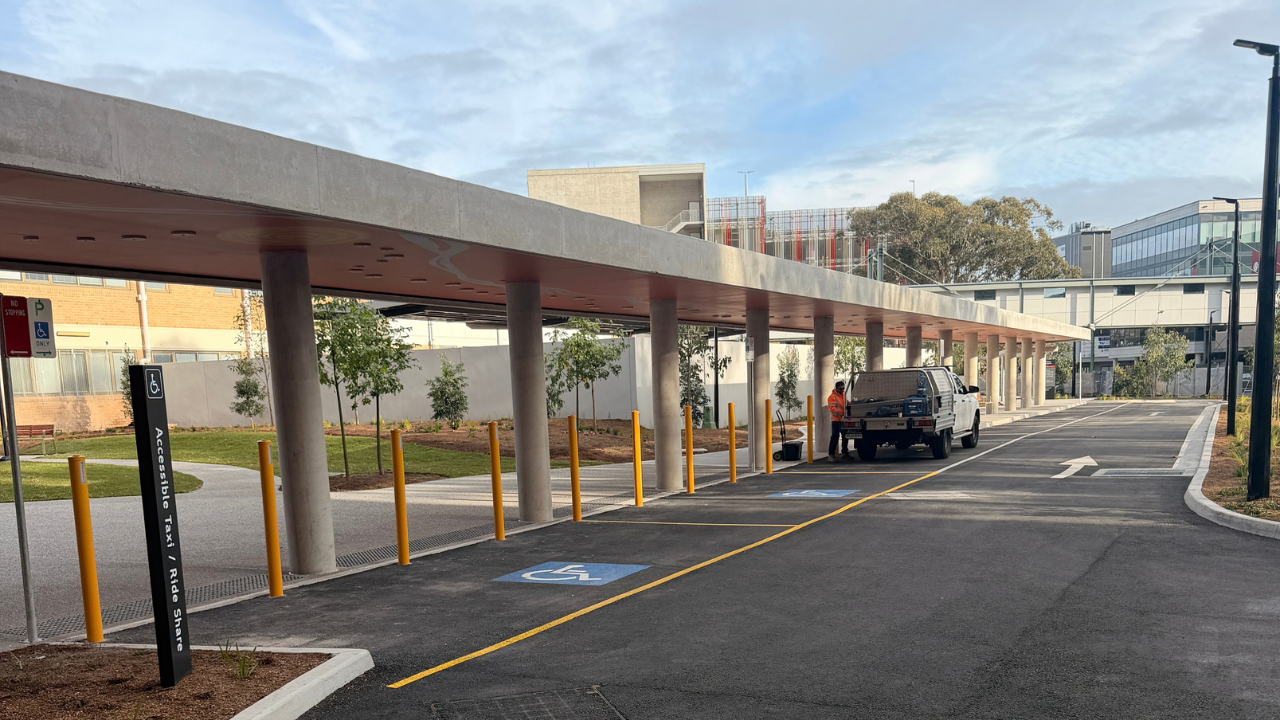
At Nepean Hospital, loose 20mm stone ballast had been incorporated across extensive rooftop areas, as well as selected areas at ground level.
The ballast itself performed several important functions. It provided a protective layer over the waterproofing membrane, helping shield it from direct UV exposure and reducing the opportunity for accidental puncture or mechanical damage. The stone layer also contributes to moderating direct solar exposure to the roof build-up and, on visible rooftops, provides a significantly more considered architectural finish than leaving exposed membrane.
For a hospital environment, where sections of rooftop may be visible from patient rooms and surrounding buildings, that aesthetic contribution was particularly valuable.
However, the advantages of loose ballast also introduce an ongoing maintenance challenge.
The challenge with loose rooftop stone
Once installed, loose stone remains exactly that — loose.
For everyday rooftop maintenance this can make relatively simple tasks considerably more difficult. Leaves and organic material can become trapped throughout the aggregate, while sweeping or using blowers can disturb and redistribute the stone rather than simply removing debris.
Movement under the feet of maintenance and service personnel can similarly displace the aggregate. Over time, repeated disturbance has the potential to create localised areas where the stone coverage becomes inconsistent, reducing the protection provided to the underlying roof system.
Wind exposure adds another consideration, particularly across large, elevated areas.
Loose aggregate can migrate across the roof during severe weather or be displaced around edges and service areas. On accessible rooftops, there is also the possibility of individual stones being moved outside their intended location.
In a hospital environment, minimising loose materials and simplifying long-term maintenance therefore had significant practical value.
The challenge was to stabilise the ballast without removing the reasons the ballast had been specified in the first place.
Why simply covering the stone wasn’t the answer
A traditional approach to retaining rooftop stone can be to install netting over the ballast.
For this project, however, netting presented several disadvantages.
The rooftop still needed to remain accessible to service and maintenance personnel. Introducing a physical layer across the surface could complicate that access, particularly around rooftop equipment and regularly serviced areas. It would also remain visibly apparent across the stone, compromising one of the aesthetic benefits of using natural aggregate in the first place.
Like any exposed rooftop component, netting can also require its own inspection and maintenance as it is exposed to UV, wind, foot traffic and general rooftop activity.
The project therefore required a system that would stabilise the aggregate itself rather than restraining it beneath another material.
AYZ Landscapes, having worked with StoneSet products on previous projects, approached StoneSet to explore an alternative.
StoneSet Pour On Gravel Binder is a single-component polyurethane system specifically designed to stabilise loose decorative aggregate while retaining the visual character of the stone.
Rather than encapsulating the entire surface beneath a coating, the liquid binder is distributed through the upper section of the aggregate and cures around the contact points between adjoining stones.
This creates thousands of bonded stone-to-stone connections across the surface.
The result is fundamentally different to simply sealing a roof.cThe stone remains recognisably stone, the natural texture remains exposed and water can continue moving through the void structure between the aggregate.
For a rooftop ballast application, that distinction is critical. The intention was not to create a conventional resin-bound pavement or introduce a new waterproof layer over the roof. The existing ballast still needed to perform as ballast; Pour On was used to stabilise the loose aggregate and substantially reduce its ability to migrate under wind, maintenance activity and general disturbance. The polyurethane binder is UV-stable and PFAS-free, making it suitable for long-term external exposure while allowing the natural colour and texture of the aggregate to remain visually dominant.
Because the application was predominantly to non-trafficable rooftop areas, it was also particularly well suited to the intended use.
Application methodology
The success of a gravel-binding system depends just as much on the preparation and application as it does on the binder itself.
The existing 20mm stone was first placed and levelled to establish an even surface.
Before application, the aggregate needs to be suitable for bonding. Loose contamination, excessive dust and moisture can interfere with the resin’s ability to properly wet and bond to the stone, so the aggregate condition is an important part of the installation process.
Once the surface was ready, Pour On Gravel Binder was installed in two separate applications of approximately 0.8kg/m² per coat.
Applying the system in two controlled passes provided more uniform distribution through the surface aggregate than attempting to deliver the full quantity in a single heavy application.
For the main rooftop areas, the installation method was remarkably simple.
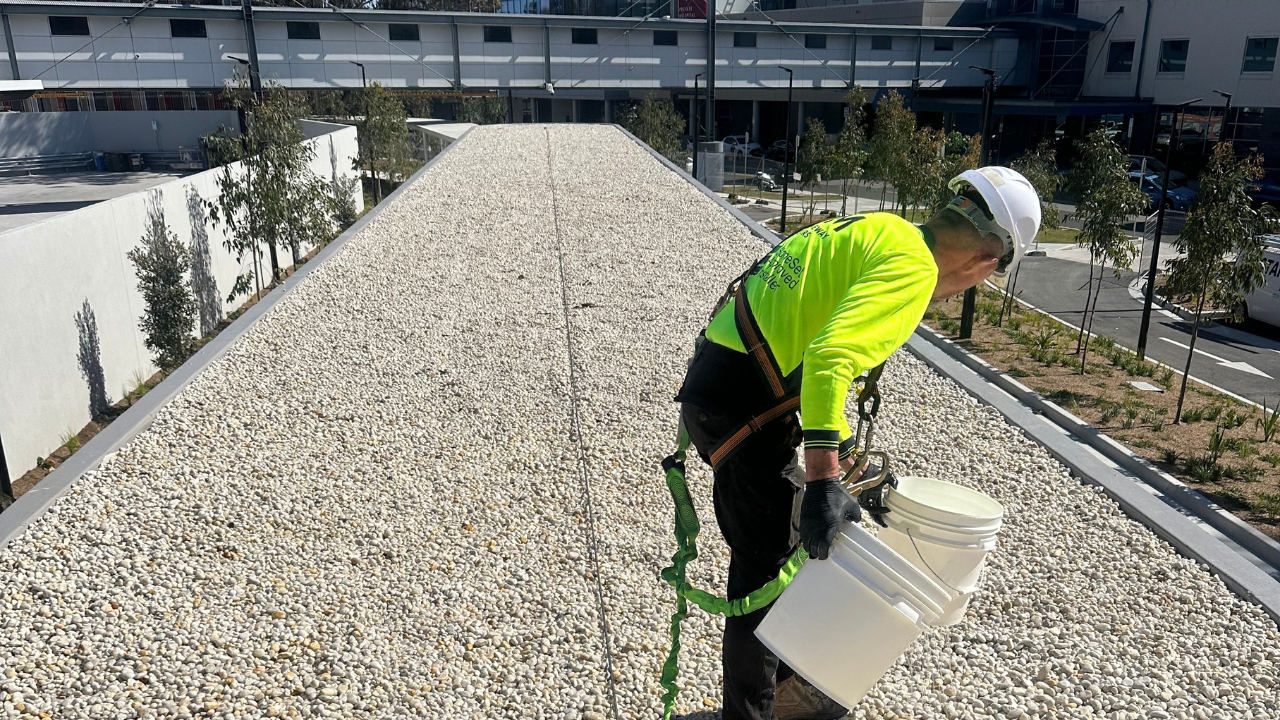
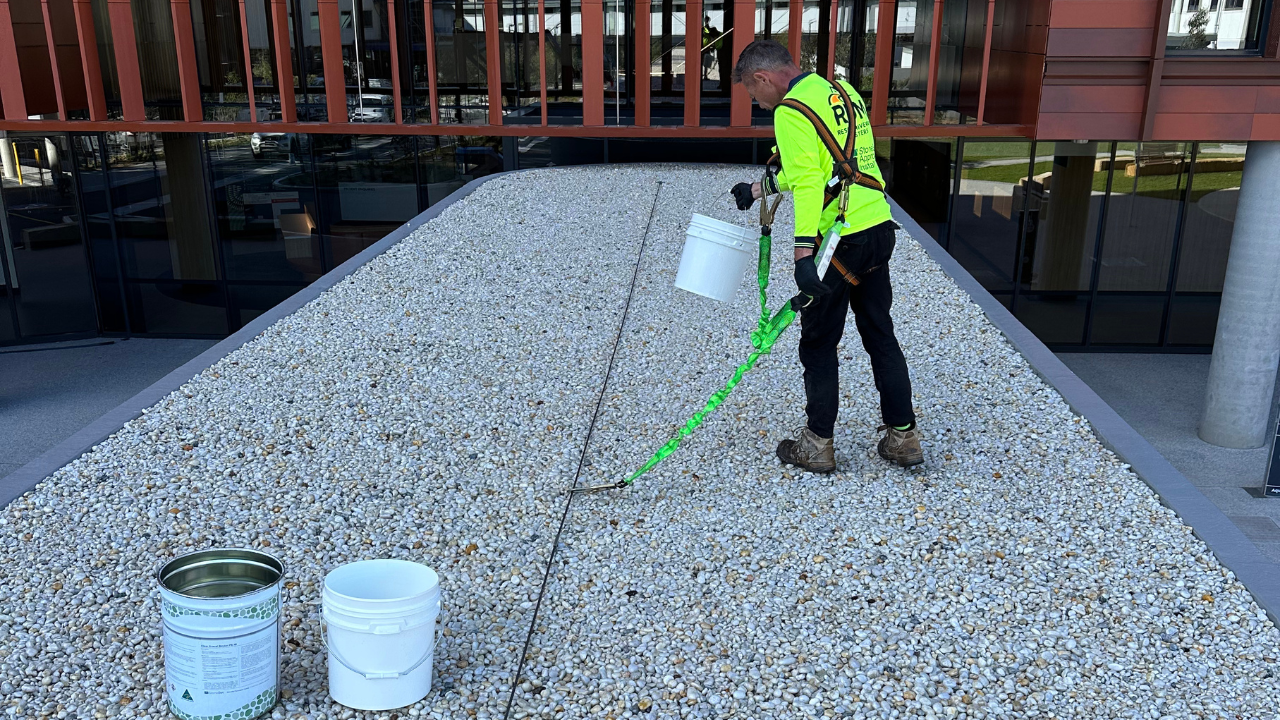
Small approximately 3mm holes were drilled into the base of application buckets. The binder could then be poured into the bucket and distributed in a controlled shower over the prepared aggregate.
The installer moved systematically across the surface, allowing the resin to fall evenly through the stone rather than being poured heavily into isolated locations.
This helped maximise the number of bonded contact points while avoiding unnecessarily flooding individual sections of aggregate.
Edges, penetrations and areas requiring greater application control were treated separately using a smaller application bottle with a single opening.cThis allowed the installation team to accurately apply resin around boundaries and detailed areas without unnecessarily coating adjoining surfaces.
The first application was allowed to cure sufficiently before the second coat was installed, further strengthening the interconnected stone matrix.
Importantly, the objective is not to fill every void between the stones.
Maintaining those interconnected voids allows the system to retain the free-draining characteristics of the aggregate while the polyurethane bonds neighbouring particles together.
1,100m² installed in five days
One of the biggest advantages of the system became apparent during construction.
Approximately 1,100m² of aggregate was stabilised over a total installation period of only five days.
Across an area of this scale, that represents an average of approximately 220m² of completed application per day.
There was no requirement to individually mechanically restrain sections of stone or progressively install and secure large areas of rooftop netting.
Once the aggregate was appropriately prepared and levelled, the installation team could progress systematically across large areas using a relatively simple application process.
For a large operational facility such as a hospital, reducing installation complexity and the amount of time trades need to spend working across rooftop areas can be a considerable advantage.
The system also leaves the rooftop visually almost unchanged. Rather than seeing mesh, netting or another retention system over the aggregate, the finished surface continues to present as natural stone — except the previously loose particles are now bonded together.
More than an aesthetic treatment
The Nepean Hospital project demonstrates an important distinction when considering loose stone areas. Pour On Gravel Binder wasn’t introduced simply to make the ballast look better. The ballast already looked good.
Its role was to make the existing rooftop design easier to live with. The stone could continue providing protection to the roof system and retain its natural, free-draining appearance, while the binder addressed many of the practical disadvantages traditionally associated with loose aggregate.
The completed system provides:
- significantly reduced movement and displacement of loose aggregate;
- easier removal of leaves and general rooftop debris;
- improved stability beneath maintenance personnel;
- reduced likelihood of localised stone migration exposing areas below;
- retention of the natural stone appearance;
- retention of the aggregate’s open void structure and drainage characteristics;
- no visually intrusive netting over the finished surface; and
- a system that can be maintained in future through additional binder application where required.
For large rooftop landscapes and ballast areas, the result is a relatively simple change with a substantial operational benefit.
Keep the ballast. Keep the drainage. Keep the natural stone finish. Remove much of the maintenance problem created by loose stone.
At Nepean Hospital, StoneSet Pour On Gravel Binder allowed approximately 1,100m² of rooftop stone to be transformed from a loose aggregate surface into a stable, maintainable system — with the entire binding installation completed in just five days.