

|
Application |
Commercial Tile Resurfacing |
|
Colour |
6mm Glensanda, 6mm Koonunga & 6mm Beach |
|
Base |
Old tiled surface |
|
Area |
1,203m2 |
|
Depth |
18mm |
|
Time to install |
23 working days |
Project Overview
Initially engaged by JLL (client) & Arcadia (Landscape Architect) in early 2024, the Citadel Towers project had just reached completion of a large-scale internal fit-out and was in dire need of upgrades to the expansive forecourt that serves as the primary entrance & outdoor space for circa 2,000+ professionals & locals on any given day.
The area equated to over 1,200m², consisting of old, weathered & dated tiles, along with painted garden beds and seating surrounding both towers and the centralised street-side café. With thousands of professionals, countless large businesses including PepsiCo operating from the buildings daily, and a consistently busy café frontage, the prospect of demolishing the forecourt presented significant challenges:
- Extensive disruption in the form of access restrictions & noise to both towers & café, impacting tenant productivity & satisfaction.
- Substantial demolition & reconstruction costs to the client.
- Creation of additional works including waterproofing above the underground carpark & the risk of unforeseen structural damage.
Arcadia sought a paving system & overall design approach that would eliminate the need for mass demolition. Short-term coating solutions such as spraycrete were not considered viable due to ongoing maintenance requirements & re-installation cycles. Traditional hardscape materials such as pavers & tiles were also unsuitable, they cannot be installed over an undulated tiled surface without complete re-screeding, significantly increasing finished heights, which still poses risks due to the lack of ability to tolerate base movement without shifting, cracking or lifting.
Following a detailed site assessment, StoneSet determined that despite the surface appearing to require full demolition, this was in fact unnecessary. Leveraging StoneSet Premium’s unique functionality, the existing tiled substrate could be retained as the structural base. Only localised repairs to isolated delaminated & drummy tiles were required prior to installation – a major win for the client.
Given StoneSet’s method of installation, mixed onsite & hand-laid, the system can be installed over undulating substrates while maintaining minimum thickness & structural integrity. Its fully bound, strong yet flexible nature allows it to accommodate minor base movement within the existing tiled layer without delamination.
Combined with the construction of new garden beds, decking, seating & a raised turf picnic area – all built over the retained base course – the transformation was achieved without major demolition. The result is an inviting, vibrant & nature-filled plaza designed to service the bustling business precinct efficiently & long-term.
The project was expertly managed & facilitated by Baseline Projects.


Expansion Joint Reflection
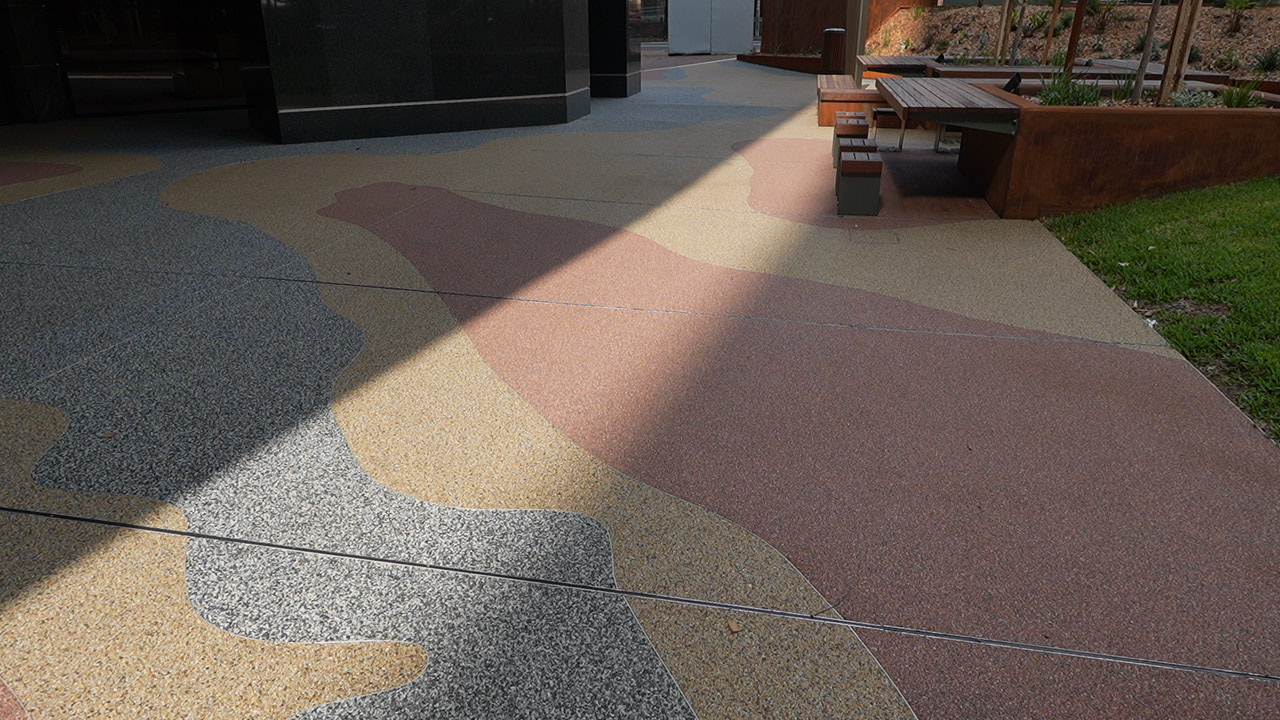
The existing tiled surface contained over 350Lm of neoprene expansion joints designed to accommodate movement. To repurpose the substrate without disturbance and prevent reflective cracking, these joints were required to be mirrored through the new StoneSet surface.
StoneSet installed 18mm x 40mm aluminium angle either side of each joint to create full separation, incorporating a 10mm expansion gap with joint sealant. With thorough mechanical fixings and complete isolation, the StoneSet system is able to replicate movement at the original joints without compromising the integrity of the new paving layer.

Base Preparation
Despite its aged appearance, the existing tiled substrate was largely structurally sound. Only isolated damaged, loose or drummy tiles were selectively removed to avoid unnecessary disturbance to surrounding areas. Where required, sections were reinstated using a high MPa repair compound such as Ardex. Other areas of base alterations were at transitions to doorways & adjacent level surfaces to allow for a seamless transtion and tie in.
To further reinforce the system and mitigate potential base movement, the entire 1,200m²+ surface was overlaid with a fibreglass mesh prior to installation of the StoneSet layer.


Achieving the Specified Pattern
Central to the vibrancy of Arcadia’s design was a multi-coloured Autumn palette incorporating three distinct StoneSet Premium blends.
To execute this accurately, a surveyor set out the pattern directly onto the existing tiled surface using line marking paint. 18mm formable aluminium angle was then installed along these markings to create a clean, minimal separation between each colour.
The angle was thoroughly mechanically fixed and bonded to ensure a tight fit to the substrate. StoneSet was then hand-laid within each section in strict accordance with the architectural drawings, bringing the design intent to life. In total 1km of formable angle was utilised.


Drainage & Services
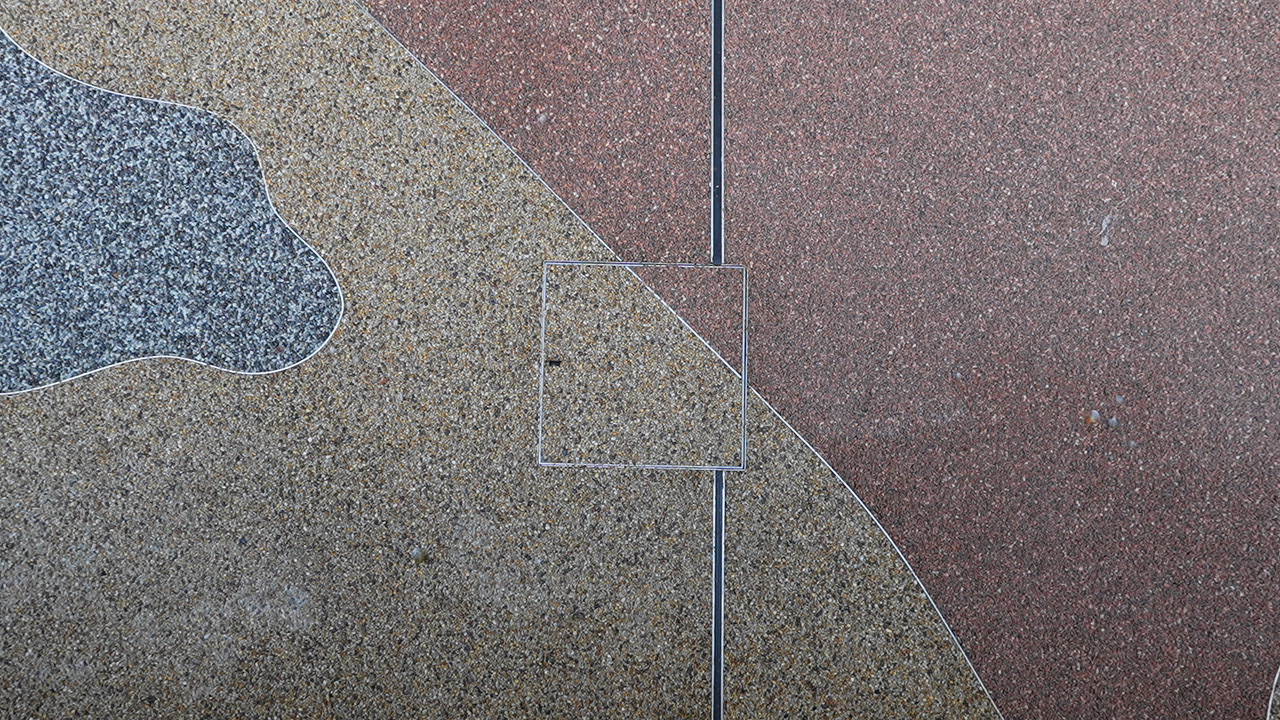
Existing drains & services were lifted and adjusted to suit the new 18mm StoneSet depth, then fitted with HIDE access covers to achieve correct finished heights and a seamless aesthetic.
Once in-filled with StoneSet, the covers maintain full functionality, with water continuing to drain effectively through the system due to StoneSet’s voided, permeable structure.

StoneSet Premium Installation
The StoneSet Premium system was installed at an 18mm depth. Given the high-traffic nature of the forecourt, an increased commercial grade resin ratio was specified to deliver enhanced strength and long-term performance, suitable for heavy pedestrian use and unforeseen loading.
Inclusive of all preparation works, expansion joint reflection and formable angle installation, the 1,200m²+ performance surface was completed in just 24 working days, ensuring exceptional efficiency and minimal disruption to tenants and businesses.
Key performance benefits include:
- P5 slip resistance
- Fully permeable surface, eliminating delamination risk and reducing surface pooling
- Flexible and crack-resistant
- Completely UV stable


Project environmental features
|
Quantifiable data |
Figure |
|
Demolition & Waste Disposal |
The average combined depth of tile, adhesive and screed totalled approximately 100mm. Across the 1,203m² forecourt, this equated to roughly 289 tonnes of potential demolition material. By retaining the existing substrate, significant demolition costs were avoided while preventing a substantial contribution to construction & demolition (C&D) landfill waste. |
|
Embodied Carbon Reduction |
By eliminating the need for demolition and reconstruction of the existing 100mm tile and screed build-up, approximately 289 tonnes of material were retained in situ. Avoiding demolition, transport and replacement concrete works resulted in an estimated ~29 tonnes of embodied CO₂ savings. Beyond direct cost benefits, this significantly reduced the project’s environmental footprint, diverting large volumes of construction waste from landfill while avoiding the carbon intensity associated with manufacturing and installing new base materials. For commercial assets of this scale, retaining and repurposing existing infrastructure delivers measurable sustainability outcomes without compromising performance. |
|
Lifecycle Extension |
By retaining the existing 100mm tile and screed build-up, approximately 289 tonnes of structural material were preserved in situ. Rather than demolish and replace, the forecourt’s base structure was effectively extended by up to the StoneSet design life of 25+ years, reducing premature asset disposal and avoiding a full capital reset of the space. Extending the life of existing infrastructure is one of the most effective ways to lower whole-of-life carbon in commercial assets. |
|
Reduced New Concrete/Screed Production |
Replacing the existing build-up would have required approximately 120m³ of new concrete or screed. With concrete producing roughly 300kg of CO₂ per m³, avoiding reconstruction prevented an estimated: ~36 tonnes of CO₂ from material production alone. This significantly reduced embodied carbon and avoided further raw material extraction. |
|
Reducing weight & volume with a high void content |
StoneSet is made up of, on average 6.3% resin, 80.7% natural stone aggregate & recycled glass, & 13% air, with no tile glue or screeds. The 13% void content allows for 13% less:
|
|
Recycled materials |
StoneSet offers the use of recycled materials including glass & rubber in its resin bound paving systems. Within the stone blend on this project, 0.8mm recycled glass was used in the stone & resin mix to strengthen the surface & slip rating. 0.8mm recycled glass was also used as an additional grip layer, sprayed over the surface during the curing process. Although StoneSet offers recycled material in blends, for this particular project a predominantly natural stone blend was selected. |
|
Toxic impact |
StoneSet products contain no PFAS or organofluorine compounds, based on raw material declarations and supplier data. StoneSet UVR is a two-part system made from a plant oil-based resin and HDI oligomer hardener, which cures to form an inert polyurethane. Any unreacted HDI rapidly reacts with moisture to form a non-reactive substance, meaning no active chemicals are leached during application, curing, or in-service use. The final product is non-toxic, non-leaching, and poses no risk of bioaccumulation or bioconcentration in the environment. A primary component of the two component binder is a crop oil making up 37% |
