
Hard-to-soft landscaping ratios are a planning challenge that many builders and homeowners face, and understandably, it can feel like an obstacle. When you’re working to maximise internal space or create functional outdoor areas, being told how much of your site can’t be hard surface can seem limiting.
But these restrictions exist for good reason.
Why Do Hard-to-Soft Ratio Restrictions Exist?
Councils implement these controls to ensure new developments are designed with long-term environmental resilience in mind. Too much hard surfacing leads to increased runoff, urban heat, and loss of green space — all of which impact community livability and infrastructure.
Soft landscaping — whether that’s turf, planting, or permeable paving — helps:
- Absorb and redirect rainwater
- Support passive cooling through evaporation and shade
- Enable vegetation and biodiversity
- Reduce strain on stormwater systems
- Comply with frameworks like WSUD and BASIX
But for builders and homeowners, the question remains:
How do you meet these requirements without sacrificing functionality, safety or design appeal?
Resin Bound Permeable Paving: A Smarter Way to Build More, Not Less
Permeable paving, particularly high-performance systems like StoneSet, is turning what once felt like a planning compromise into a strategic advantage.
It allows builders to maximise internal floor space, preserve driveway access, and create highly functional outdoor areas — all while counting toward their soft landscaping obligations.
For homeowners, it’s an investment in a surface that not only looks great, but performs at every level.
Why Builders Love It:
- Enables larger footprints on constrained sites by offsetting hardscape elsewhere
- Complies with council planning conditions without design sacrifice
- No design compromise – Builders can meet council-imposed permeability or soft landscaping targets without losing driveways, courtyards or other key features, allowing them to preserve the lifestyle elements their clients expect
- Reduces liability with P5 slip resistance and long-term durability
- Adds resale value with natural stone finishes & low maintenance appeal
Why Homeowners Love It:
- Beautiful, seamless surface with endless stone blends to choose from
- No pooling, no loose gravel, limits weeds making for a low maintenance option
- Drains fast & dries quickly, making it safer underfoot in wet weather
- Stays cooler than traditional paving due to its permeable structure
- Protected by a 10-year guarantee when installed by an approved installer
Case Study: 58m² of Value-Added Driveway in the City of Ryde
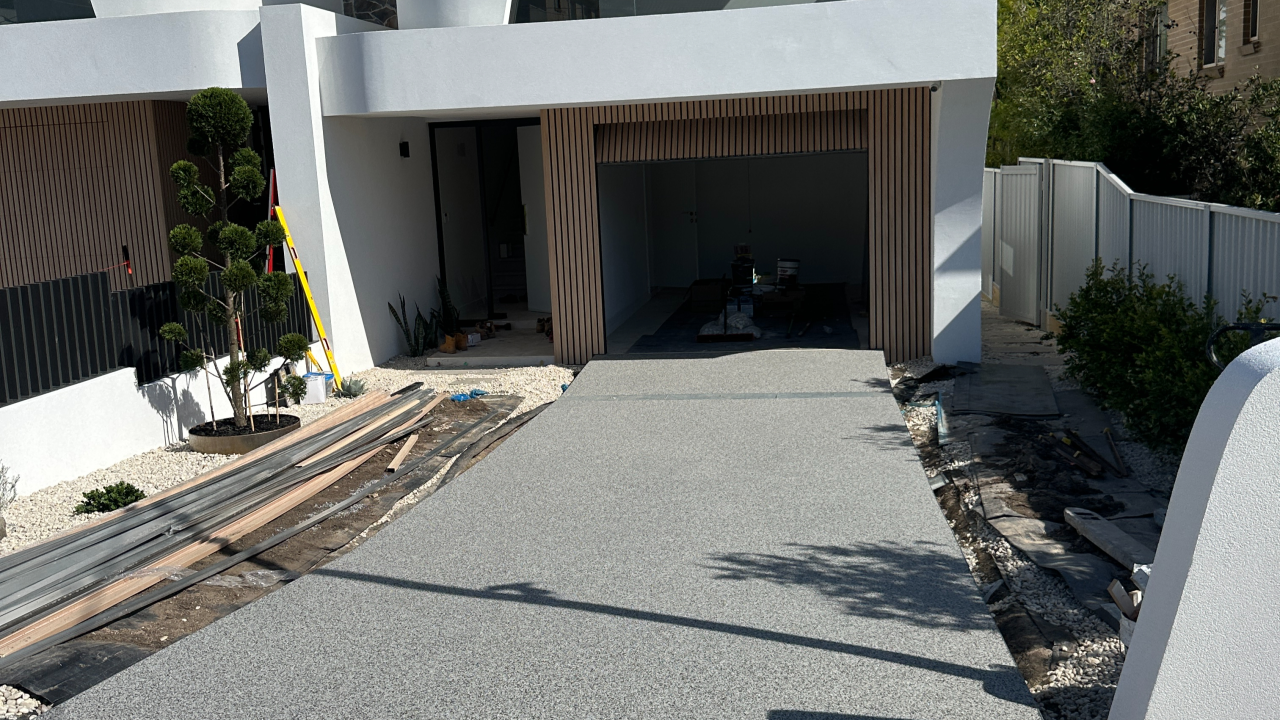
Take this recent duplex in Putney, a council known for championing water sensitive urban design. The builder was working to maximise the internal living area — but hard surface limitations meant they had to rethink the external areas.
The solution? StoneSet permeable driveways — 58 m² of fully usable surface that:
- Achieves a water flow rate of 6,000 L/m²/min
- Drains 59,990 L of rainfall annually, sending it straight back into the ground
- Provides 2,552 L of water retention
- Maintains a slip-resistant (P5) finish, even on a slope
- Matches the aesthetic appeal of premium natural stone paving
With compressive strength of 25 MPa, the driveways are built to last — and their clean, smooth look adds curb appeal and property value, delivering more than just council compliance.
Compared to Other Permeable Options?
While surfaces like deco granite, loose gravel or turf grids offer permeability, they often fall short:
- Loose stone and deco granite typically range from 10 up to 1,000 L/m²/min — far less than StoneSet’s impressive flow rates
- Many clog over time or require regular raking, re-compaction or regular weed control
- StoneSet, by contrast, is completely bound, low maintenance and designed for long-term performance
- Porosity is shallow — StoneSet permeable paving systems enables deep infiltration & retention
Making Hard-to-Soft Ratios Work for You
Permeable paving isn’t just a workaround — it’s an opportunity.
For builders, it’s a valuable design lever to achieve planning approval and build smarter. For homeowners, it’s an investment in livability, environmental responsibility and long-term property value.
Final Word:
Permeable paving is helping transform regulatory limits into market-leading features. It’s time we stopped seeing soft landscaping ratios as a restriction — and started viewing them as a chance to build better, greener, and more liveable homes.