Project overview
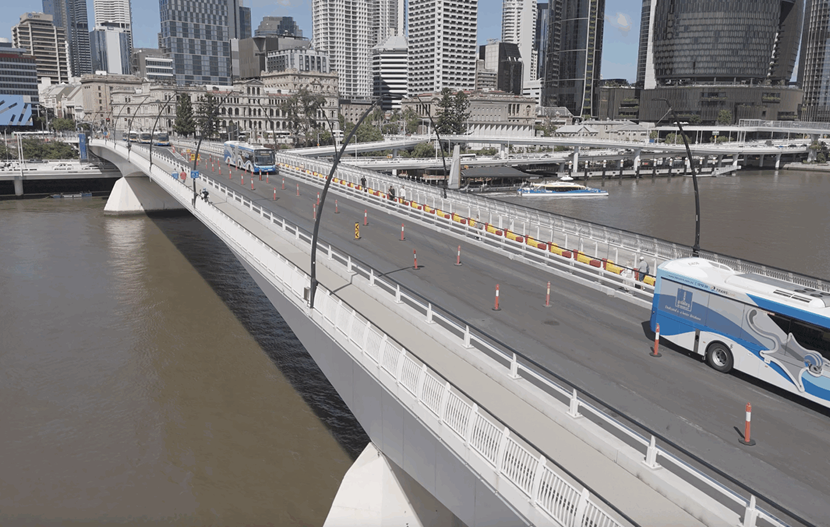
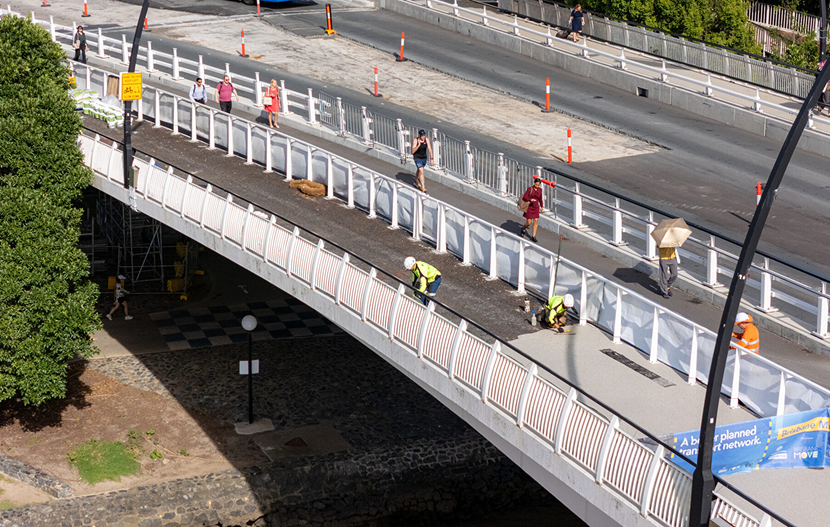
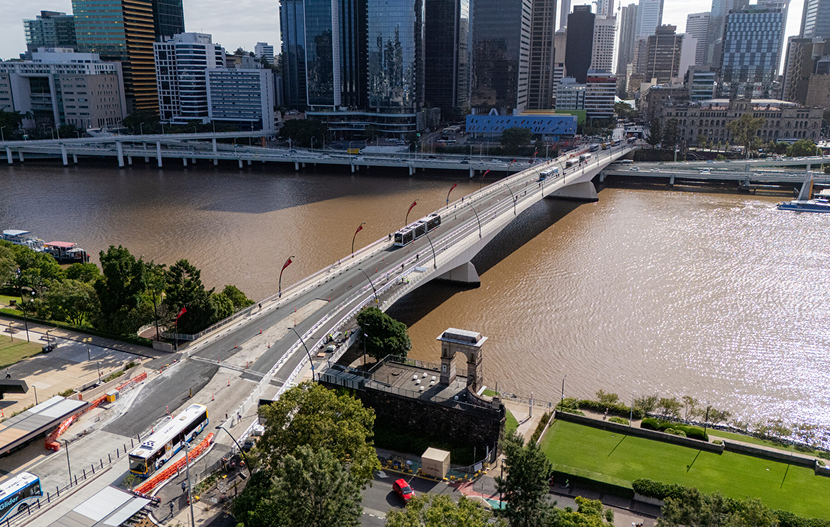
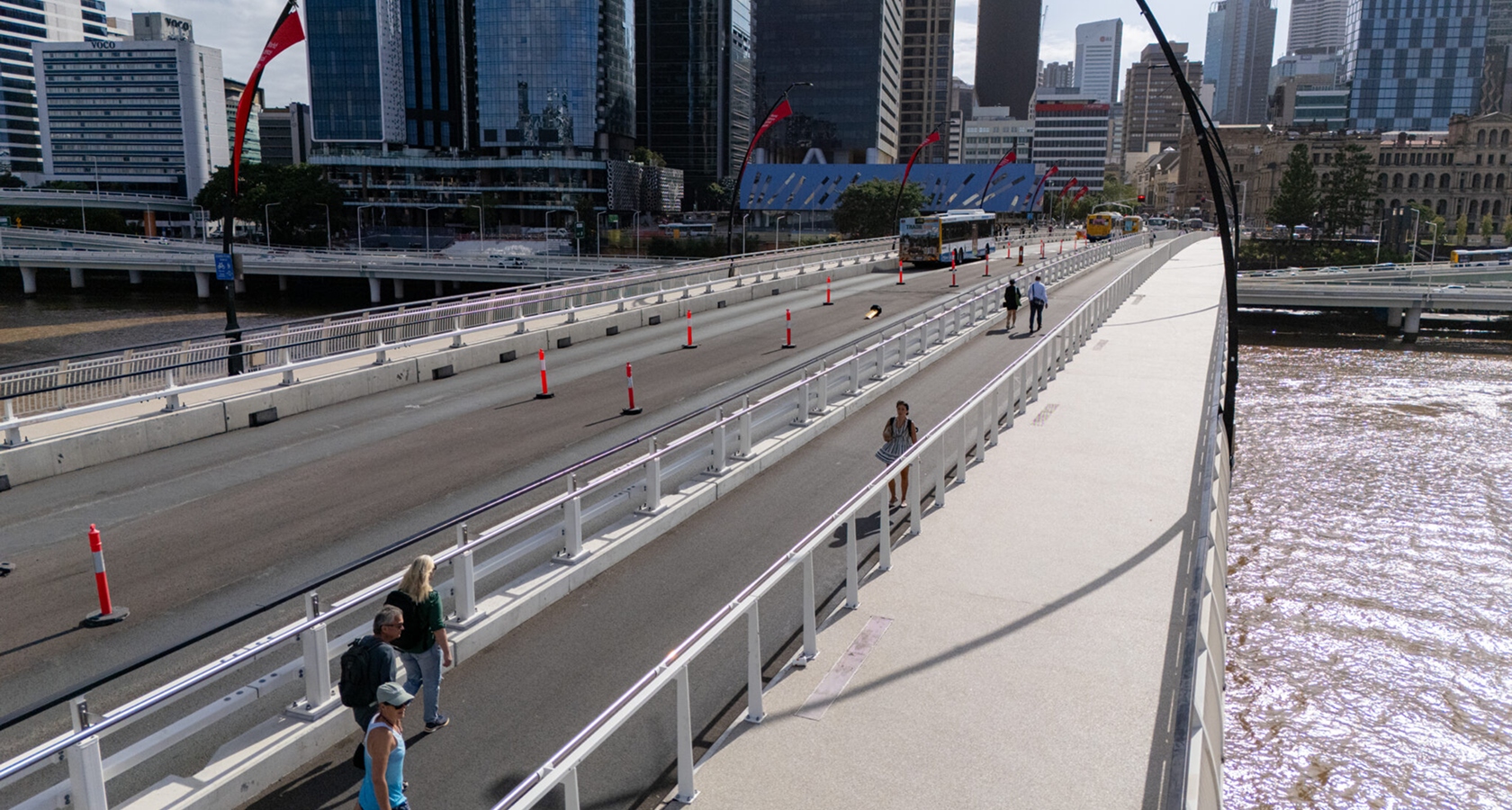
After initially being engaged in 2020, StoneSet commenced the resurfacing of footpaths on both sides of the Victoria Bridge as part of major transport upgrades carried out by Acciona on behalf of Brisbane City Council. A key motivation behind the project was to create more effective public transport & more useable, safer pedestrian & cyclist access, encouraging environmentally conscious transportation choices by the public.
The installation of StoneSet as a resurfacing application reflects Brisbane’s commitment to innovative infrastructure solutions. The surface prioritises community needs, with a permanent P5 slip rating. As a permeable product, the trafficable surface dries quickly & prevents water entrapment, reducing the risk of degradation to the underlying structure. The flexible polyurethane resin system accommodates movement within the bridge structure.
ARUP (architects), seeked a lightweight material to reduce the stress put on the bridge structure. StoneSet’s void content reduced loading by at least 14 tonnes comparing to a conventional paving product at the same depth, & that’s excluding screeds & glue.
Engineered for performance in all weather conditions, the resin system is fully UV stable & resistant to degradation from sun exposure. The carefully selected light, earthy colour delivers a high Solar Reflective Index (SRI), while the surface’s void content helps minimise heat retention.
Mixed on site, the hand laid nature of a StoneSet meant that precision prep work in the form of labour intensive grinding & leveling prior to the StoneSet installation, was not essential, as imperfections were addressed during the installation process. Making for a more time efficient installation for a naturally time pressured project. This aspect has no negative effect on the long term integrity of the surface.
A key consideration in the application was the short term & long term environmental impact.
Raw material production impacts
| Material | CO₂e per tonne (manufacturing) | Total Mass (kg) | Total CO₂e |
| Australia natural stone aggregate
(Using Australian average for aggregate producing quarries) |
5kg
(extraction, processing & internal transportation) |
71,000kg | 355kg |
Transport impacts
| Delivery |
Tonnage (including pallets consumables/ sundries) |
Total CO₂ |
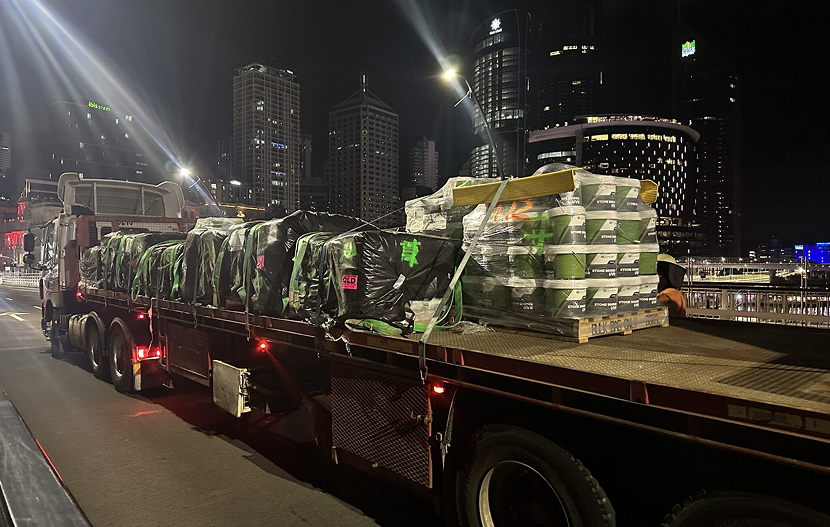
| Haulage calculated on capacity loads of 28 tonnes, totalling 5 deliveries. | 85 tonnes | 44.5 tonnes |
End of life & environmental credentials
| Aspect | Impact |
| Using quarries with strong sustainability initiatives | At StoneSet, we always research & request information about quarries commitment to sustainable production practices. Stone quarrying produces less carbon than that of carbon intensive manufacturing process of tiles, pavers & processing of limestone for cement. |
| Reducing weight & volume with a high void content. | StoneSet is made up of, on average 5.7% resin, 79.3% natural stone aggregate & recycled glass, & 15% air. The 15% void content allows for 15% less:
|
| Toxic impact | StoneSet products contain no PFAS or organofluorine compounds, based on raw material declarations and supplier data.
StoneSet UVR is a two-part system made from a plant oil-based resin and HDI oligomer hardener, which cures to form an inert polyurethane. Any unreacted HDI rapidly reacts with moisture to form a non-reactive substance, meaning no active chemicals are leached during application, curing, or in-service use. The final product is non-toxic, non-leaching, and poses no risk of bioaccumulation or bioconcentration in the environment. A primary component of the two component binder is a crop oil making up 37% of the. |
| End of life | Given the durability of the resin system, it cannot be dissolved from the stone & due to the lack of toxic effect on the environment, does not need to be.
StoneSet as a result can be crushed & reused as recycled aggregate for use in future construction projects in the form of subgrade preparations, porous back filling & more. |
| Recycled materials | StoneSet offers the use of recycled materials including glass & rubber in its resin bound paving systems. Within the stone blend on this project, 0.8mm recycled glass was used in the stone & resin mix to strengthen the surface & slip rating. 0.8mm recycled glass was also used as an additional grip layer, sprayed over the surface during the curing process.
Although StoneSet offers recycled material in blends, for this particular project a predominantly natural stone blend was selected, meaning the recycled material was limited to approx. 3,550kg in this case. All StoneSet UVR packaging is made up of 55% recycled materials. |
Project details
| Application | Concrete resurfacing (pathway) |
| Colour | Ash – Pearl blend |
| Base | Concrete/bitumen waterproofing |
| Area | 2,364m2 |
| Depth | 18mm depth (specified). 20mm average depth (actual) |
| Time to install | 21 working days |