
Have you ever watched rainwater pool across a driveway or flood a footpath after a storm? That’s the problem with traditional paving. Concrete, tiles, and conventional pavers are solid all the way through, so water has nowhere to go but sideways, into drains and gutters, and eventually into overloaded stormwater systems.
Australian weather swings between drought and downpour. This is pushing more homeowners, builders, and councils to ask a simple question. Is there a paving option that works with the water, not against it?
That’s what permeable paving does. This blog explains how it compares to traditional paving for managing stormwater, whether you’re resurfacing an old surface or installing something new.
Traditional Paving and Stormwater Problems
Traditional paving refers to hard, impervious surfaces like concrete slabs, tiles, and conventional pavers. Because these materials are solid, rain can only run off the top rather than soak in.
On a driveway, this shows up as puddles and slippery patches. On a larger surface, like a car park or public footpath, it means large volumes of water reach council drains all at once, often faster than those drains were designed to cope with.
Over time, this leads to a few recurring issues:
- Higher flood risk during heavy rain
- Erosion, as fast-moving surface water washes soil away from garden beds
- Added strain on stormwater infrastructure
- Less groundwater recharge, since water is diverted away instead of soaking into the earth
None of this is a flaw in concrete or pavers themselves. It’s simply how a solid, impervious surface behaves.
How Permeable Paving Manages Stormwater
Permeable paving lets water pass through the surface and into the ground below it, instead of blocking it.
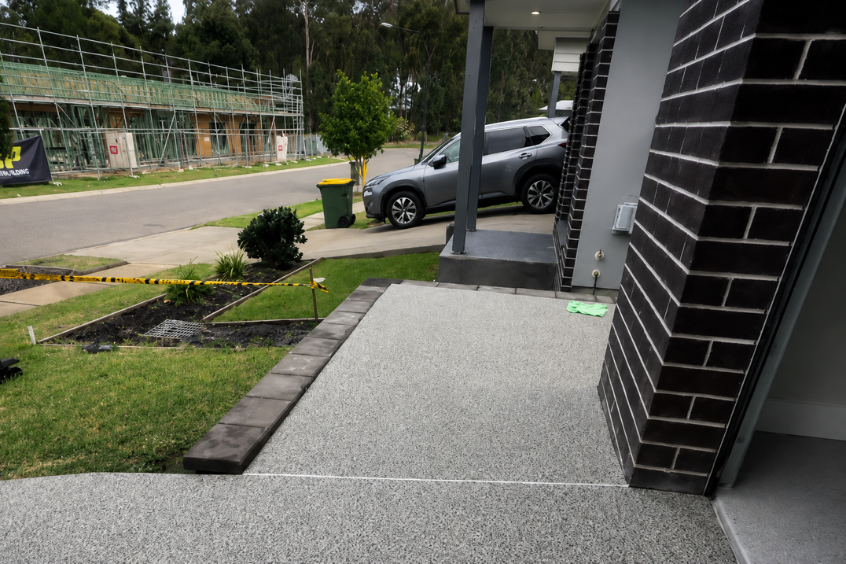
StoneSet’s resin-bound paving works this way. Natural stone aggregate is bound together with a strong, flexible resin, leaving tiny gaps throughout the surface that let rain drain straight through at rates of up to 60 litres per square metre every second. These resin bound permeable paving solutions provide a practical option for properties where effective surface water management is important.
This changes how a site handles stormwater overall:
- Runoff drops, since most rain drains through the surface instead of flowing across it
- Flood risk falls in low-lying or high-density areas
- Erosion decreases, because water isn’t concentrated into fast-moving channels
- Groundwater gets replenished naturally
- Council compliance becomes easier, since many councils count permeable surfaces as soft landscaping when assessing drainage requirements
For property owners, this often means fewer drainage issues to plan around, and in some cases, more flexibility with how much hard surface area a site can include under local planning rules.
Resurfacing vs New Installation
Permeable paving doesn’t require a full rebuild to be effective, and it doesn’t need to be installed from scratch either. Both approaches solve the same problem.
We can install a permeable resin-bound layer directly over an existing concrete driveway, tiled courtyard, or aging car park without demolishing what’s already there, as long as the existing base is structurally sound.
For residential permeable pavers, an old driveway, pool surround, or pathway that used to collect puddles can be resurfaced to drain properly, without a full rebuild.
For commercial paving resurfacing, the same principle applies at scale. Car parks, walkways, and public plazas can be upgraded without demolition, which reduces both construction disruption and the volume of stormwater reaching public drains during heavy rain.
Alternatively, for a new build or major redevelopment, a fully permeable surface can be installed from the ground up instead.
Why Polyurethane Resin-Bound Paving Lasts
Not every permeable surface keeps draining well long-term. Loose gravel and decomposed granite let water through when freshly installed, but fine particles gradually compact and clog the gaps between stones, so drainage performance drops off over the years.
Polyurethane resin-bound paving avoids this, because the stone is fully bound within a flexible resin matrix rather than sitting loose. The structure doesn’t compact or shift, so the gaps that let water through stay open for years, not just when the surface is new.
StoneSet’s resin-bound paving specifically offers the following:
- Strength to handle vehicle traffic without cracking
- Flexibility to handle minor ground movement without the surface breaking apart
- UV stability, so the Australian sun doesn’t degrade the resin over time
- A 10-year guarantee against loose stone, delamination, and resin discolouration
The use of UV stable resin paving is particularly important in Australian conditions, where surfaces can experience prolonged exposure to strong sunlight and changing weather conditions.
Together, these qualities mean the surface stays structurally intact for years, which keeps the drainage gaps clear and the surface performing the way it did when it was newly installed.
Choosing the Right Approach
Traditional paving still has its place, particularly where permeability isn’t a priority. But where stormwater management matters, whether that’s reducing flood risk, meeting council drainage requirements, or simply stopping a driveway from pooling after rain, permeable paving addresses the problem that traditional paving cannot.
Whether you’re resurfacing an existing commercial car park or installing a new residential driveway, get in touch with the StoneSet team for advice specific to your site and a free quote.