
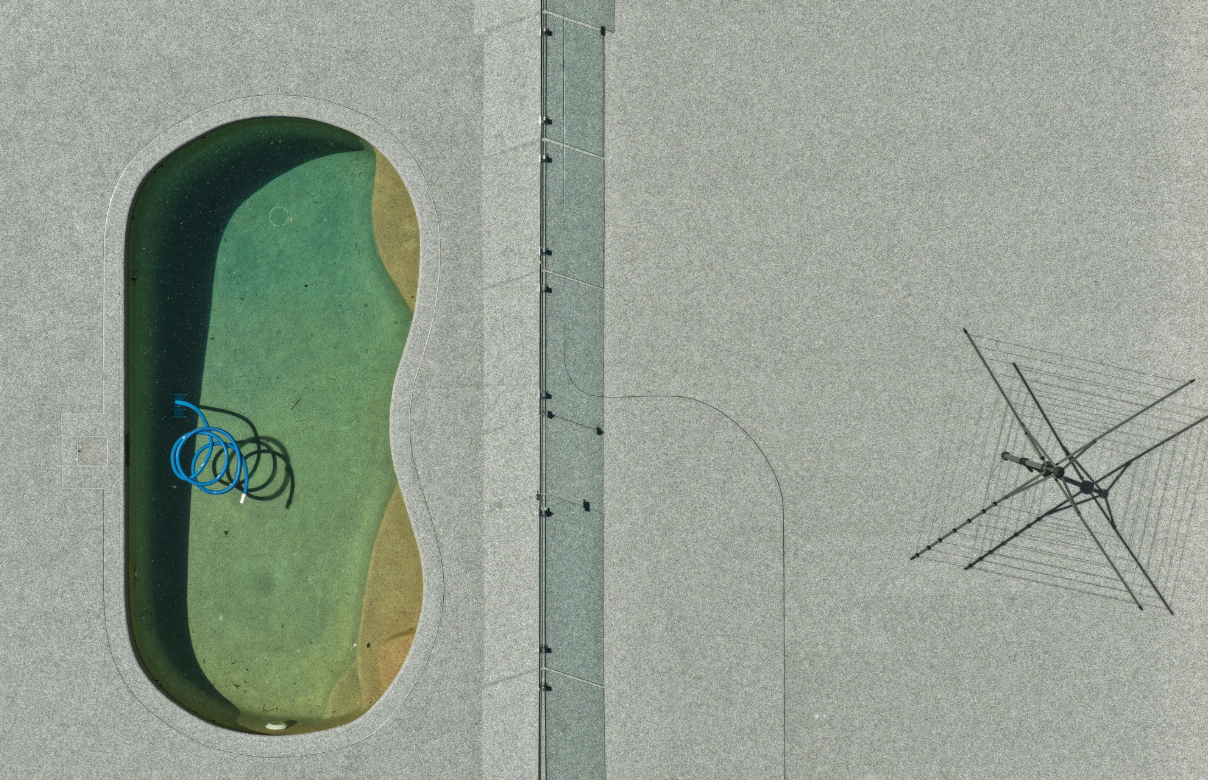
When upgrading an existing pool surround, the choice of paving material is about far more than aesthetics. Slip resistance, surface temperature, drainage and ongoing maintenance are all important considerations, particularly in an area regularly exposed to water and direct sunlight.
This residential project in Revesby, NSW, completed by StoneSet Approved Installer Resin Driveway Masters, demonstrates how an existing concrete pool surround and adjoining outdoor entertaining area can be completely transformed without the need for extensive demolition.
The project also showcases the versatility of combining StoneSet Premium UVR, Mesh & Go and VertiStone to achieve a consistent natural stone finish across both horizontal and vertical surfaces.
Project overview
| Location | Revesby, NSW |
| Application | Pool surround & outdoor entertaining area |
| Approved Installer | Resin Driveway Masters |
| Colour | 6mm Sierra Grey |
| Existing substrate | Concrete |
| Area | Approx. 150m² |
| StoneSet depth | 16mm |
| Systems | StoneSet Premium UVR, Mesh & Go, VertiStone |
| Wet pendulum slip rating | P5 |
| Installation | 2 days |

Working with the existing concrete
The existing pool surround and outdoor entertaining area consisted of several concrete pours, with inconsistent finishes and irregularly positioned joints. The traditional pool coping also created a visual separation between the pool itself and the surrounding paving.
Rather than removing otherwise functional concrete, the installer was able to utilise the existing surface as the structural base for the new StoneSet finish.
As with any resurfacing project, understanding the condition of the existing substrate, its drainage characteristics and its potential for movement is critical to the long-term performance of the finished surface.
Several elements of this installation were particularly important.


Surface preparation & transition detailing
Localised grinding was undertaken around the existing strip drain and at adjoining surfaces. This accommodated the additional depth of the StoneSet overlay, maintained the functionality of the existing drainage infrastructure and allowed for neat transitions between surfaces.
Managing substrate movement with Mesh & Go
With several separate concrete pours forming the existing base, StoneSet’s Mesh & Go system was incorporated across relevant areas to manage the potential for reflective cracking.
Mesh & Go is a triple-layer fibreglass mesh system that introduces approximately 200kN of tensile reinforcement while creating a degree of separation between the StoneSet and the underlying substrate.
This decoupling effect helps accommodate minor differential movement between existing concrete sections, significantly reducing the likelihood of relatively inactive joints and imperfections reflecting through the new surface.
Mesh & Go does not, however, eliminate the need for expansion joints. The primary movement joint separating the pool shell from the surrounding concrete was reflected through the StoneSet, allowing these independent structures to continue moving as intended.
Resurfacing with StoneSet Premium UVR
The horizontal surfaces were resurfaced with 6mm Sierra Grey at a nominal depth of 16mm, using StoneSet’s premium UV-stable polyurethane resin technology.
The result is a naturally textured, permeable stone surface that brings consistency to what was previously a combination of mismatched concrete finishes.
Extending the finish with VertiStone
One of the more impactful elements of this project was the treatment of the existing pool coping.
Using VertiStone, StoneSet’s specialist vertical resin technology, Resin Driveway Masters was able to continue the natural stone finish down the exposed vertical faces of the existing coping.
Rather than retaining the contrasting brown edges or undertaking the costly process of replacing the coping, VertiStone allowed the pool edge to become a cohesive part of the surrounding paving.
A new HIDE skimmer lid and drain cover were also incorporated, further reducing visual interruptions across the finished area.
Does resin bound stone get hot around a pool?
Surface temperature is an important consideration when selecting any external paving material, particularly around a swimming pool where the surface is regularly used by bare feet.
There are several characteristics of resin bound stone that influence its thermal performance.
Unlike dense, non-permeable surfaces, StoneSet has an interconnected open-void structure between the individual stones. This allows both air and moisture to move through the surface.
Even when installed over an impermeable concrete base, moisture can enter the void structure of the StoneSet overlay before draining or evaporating. As this moisture evaporates, it draws heat from the surrounding material, providing a degree of evaporative cooling while moisture remains present.
However, one of the most significant considerations when selecting a pool surround is the colour of the stone itself.
Understanding Solar Reflectance Index (SRI)
The Solar Reflectance Index, commonly referred to as SRI, is a measure of a material’s ability to reflect solar radiation and release absorbed heat.
Generally, materials with a higher SRI will reach lower surface temperatures under comparable conditions.
Lighter natural stone blends typically reflect more solar radiation, while darker blends absorb more of it. This makes colour selection particularly important for pool surrounds exposed to prolonged periods of direct sunlight.
StoneSet has undertaken SRI testing across a selection of its natural stone colours, allowing homeowners, architects and landscape designers to make more informed decisions when selecting a surface.
For this project, 6mm Sierra Grey was selected for its contemporary silver-grey appearance. While it offers a visually balanced finish, lighter colours within the StoneSet range may be more appropriate where minimising surface temperature is a primary consideration.
As with any external paving material, actual surface temperatures will vary depending on colour, moisture content, shade, ambient temperature and exposure to direct sunlight.
Further reading: SRI Values – How StoneSet is Keeping Surfaces Cool Underfoot.


Is resin bound stone slippery when wet?
One of the key advantages of resin bound stone in a pool surround application is its inherent surface texture.
Rather than relying on an applied anti-slip coating or a manufactured surface pattern, the texture is formed by the individual pieces of natural stone that make up the surface.
The individual aggregates are bound together using a clear polyurethane resin, retaining the natural contours of the stone while creating a consistent, durable paving finish.
StoneSet Premium UVR surfaces can achieve a P5 wet pendulum slip resistance classification in accordance with AS 4586, the highest classification achievable under this particular testing method.
The 6mm Sierra Grey blend selected for this project achieves a P5 wet pendulum slip rating.
The permeability of the surface also plays an important role. By allowing water to enter the interconnected voids between the stones, surface water is able to move away from the immediate walking surface rather than remaining as a continuous film.
The combination of natural surface texture and effective water management makes StoneSet particularly well suited to pool surrounds and other external wet areas.
As with all paving materials, appropriate drainage, regular cleaning and the removal of contaminants such as algae remain important in maintaining slip resistance over the life of the surface.
Where does the water go when StoneSet is installed over concrete?
A common misconception is that permeable paving must always be installed over a permeable base.
One of the unique advantages of StoneSet is its ability to be installed as either a fully permeable paving system or as a permeable resurfacing system over an existing hard surface.
In this particular application, the underlying concrete remains impermeable. Water is not intended to infiltrate into the ground; instead, the existing falls and drainage infrastructure continue to manage surface water.
Water can pass through the depth of the StoneSet and travel through its interconnected void structure along the underlying concrete towards suitable drainage outlets. Depending on the volume of water and the drainage configuration, water may also travel across the finished surface.
This offers several advantages in a pool surround application:
- Water is able to move away from the immediate walking surface.
- The open-void structure allows moisture within the overlay to evaporate.
- Existing drainage infrastructure can often be retained and incorporated into the new finish.
- Water is less likely to become trapped at the interface between the new surface and the existing concrete, provided appropriate drainage is maintained.
As with any resurfacing application, StoneSet’s permeability is not a substitute for adequate falls and drainage. These are important considerations when assessing the suitability of an existing concrete surface for resurfacing.
Selecting a natural stone colour for your pool surround
For this Revesby project, the homeowners selected 6mm Sierra Grey, a natural marble blend featuring a combination of soft grey and silver tones.
The subtle variation within the stone creates visual depth without dominating the surrounding landscape, complementing both the pool water and adjoining outdoor entertaining area.
Unlike coloured concrete coatings or manufactured paving products, StoneSet’s appearance comes from the natural stone itself. Our clear, UV-stable resin allows the natural characteristics of the aggregate to remain the defining feature of the finished surface.
When selecting a colour for a pool surround, there are several factors worth considering:
- Solar exposure: Consider lighter, higher-SRI blends where the area receives prolonged direct sunlight.
- Existing architectural finishes: Select a stone that complements the pool interior, surrounding landscaping and external finishes of the home.
- Aggregate size: Different stone sizes offer different surface textures and visual characteristics.
- Surrounding vegetation: Natural variation within certain stone blends can help disguise everyday dust, leaf litter and other minor debris between cleans.
We always recommend viewing physical stone samples in the environment in which they will be installed. Natural stone can appear quite different depending on lighting conditions, surrounding colours and whether the surface is wet or dry.
The result: a complete transformation without demolition
Across approximately 150m² of existing concrete, Resin Driveway Masters was able to create a cohesive natural stone finish that extends from the pool coping through to the adjoining outdoor entertaining area.
By retaining the existing concrete, the project avoided the unnecessary demolition, disposal and replacement of an otherwise functional substrate.
The combination of StoneSet Premium UVR, Mesh & Go and VertiStone demonstrates how several complementary systems can be used to address both the technical and aesthetic challenges of resurfacing an existing pool surround.
Completed across just two installation days, the project is a great example of how an existing outdoor space can be transformed through considered material selection, appropriate preparation and attention to detail.
Frequently asked questions
Can StoneSet be installed over existing pool tiles, pavers or concrete?
Yes. Provided the existing surface is structurally sound and suitable for resurfacing, StoneSet can be installed directly over a range of hard surfaces with the appropriate preparation and reinforcement.
Is StoneSet suitable for saltwater and chlorine pools?
Yes. StoneSet Premium UVR utilises a polyurethane resin technology suitable for normal exposure to both saltwater and chlorinated swimming pool water. Concentrated pool chemicals should not be allowed to remain on the surface.
Can StoneSet be applied to existing pool coping?
Yes. StoneSet can be used on suitable horizontal coping surfaces, while VertiStone allows the natural stone finish to continue down vertical coping faces, step risers and adjoining walls.
How do you maintain a resin bound pool surround?
Routine sweeping, rinsing and occasional pressure cleaning are generally all that is required. A maintenance resin roll coat can also be applied as required throughout the life of the surface to refresh its appearance and support long-term performance.
Does StoneSet come with a warranty?
StoneSet Premium UVR is backed by a 10-year product warranty against loose stone, subject to the applicable warranty conditions.
Considering resurfacing your existing pool surround?
Whether you’re working with existing concrete, tiles or pavers, StoneSet offers an alternative to traditional demolition and replacement, combining the appearance of natural stone with the practical benefits of a permeable, slip-resistant paving surface.
Our team can assist with system selection, technical advice and colour samples, as well as connect you with a StoneSet Approved Installer in your area.
Contact StoneSet on 1300 392 155 or submit an enquiry to discuss your project.